It's the last Tuesday of October. Your first appointment started at 8:30 this morning and your last one wrapped after 6. Somewhere in between, eleven voicemails stacked up, four clients called confused about a letter their carrier sent, and the follow-up notes you promised yourself you'd finish over the weekend are still sitting on a legal pad in your bag.
It's 9:40 at night, and you're doing paperwork.
Not because you're behind on selling. Because you're succeeding. Every appointment you win during the Annual Enrollment Period generates another hour of work nobody pays you for - the recap letter, the scope documentation, the to-do items, the plan details you swore you'd double-check before Thursday.
Here's the thing about that Tuesday night: it doesn't get decided in October. It gets decided now, in August, while your calendar still has room to breathe.

Enrollment season is won before it starts
AEP prep with AI means building, testing, and rehearsing your AI support systems in August and September, so that enrollment season runs on workflows that already work instead of experiments you abandon by week two.
The Annual Enrollment Period runs October 15 through December 7, and every agent reading this knows what those eight weeks feel like. The agents who have a different October are the ones who built in August. You cannot construct a workflow in the middle of the storm that workflow was supposed to survive.
And I know what August already looks like for you. You're grinding through AHIP recertification and carrier certifications right now, on top of everything else. That's exactly why building a system feels impossible to schedule - and exactly why the agents who do it anyway have a different season than everyone who didn't.
You don't need a technology department for this. You need a Digital Crew - a governed team of AI agents with named roles and a human manager, built to take the busywork so you get back to the work only you can do. You're the manager. The crew works for you. And there's a right order to hire them in.
What 200 Medicare agents asked for first
Last week I delivered a virtual keynote and workshop for Berwick Insurance Group, with about 200 Medicare agents in the room. During the session we ran an Admin Drag audit - a look at where the week actually goes - and collected 53 responses from working agents.
When we got to the build conversation, the number one request wasn't a lead machine. It was an appointment scribe.
Two hundred people whose income depends on winning new clients, and their first ask was help with the paperwork that follows the appointment. They already know where the season goes sideways. It's not the selling. It's the drag that follows the selling.
So that's where your build order starts.
Build one: the Scribe
The Scribe handles documentation - the work that piles up behind every client conversation. Recap letters. To-do capture. The notes that keep you compliant and keep your promises from slipping through the cracks.
Building one is simpler than most agents expect. You take your best follow-up letter - the one where you nailed the tone, covered the details, and the client wrote back to thank you - and you teach an AI assistant to produce that structure from your raw notes. You review everything before it goes anywhere. The Scribe drafts; you decide.
Don't just take my word for the simplicity. Here's the starter instruction I give agents, word for word. Paste it into your AI assistant and adjust from there:
You are my appointment Scribe. After each client meeting, I will paste my raw notes. Your job, every time:
- Draft a client follow-up letter in my voice - warm, plainspoken, no industry jargon. I've pasted my best follow-up letter below. Match its structure and tone exactly.
- Pull out every commitment I made in the meeting as a dated to-do list.
- Flag anything in my notes that looks like a loose end - a missing document, an unanswered question, a follow-up I promised but didn't date.
Never invent details that aren't in my notes. If something is unclear, ask me instead of guessing.
[Paste your best follow-up letter here.]
That's it. That's the whole starting point. Test it on sample notes, not client files, until you've confirmed your compliance footing - more on that below. Start now, in August, on your current non-AEP appointments, and by the time enrollment opens, producing your follow-up documentation should feel like reviewing, not writing.
Build two: the Scout
The Scout researches. And late September hands the Scout its first real job, because your clients' Annual Notice of Change letters arrive by the end of the month - and then your phone starts ringing.
Every ANOC season, the same thing happens: plans change, clients panic, and you spend hours cross-referencing documents to answer the same question fifty different ways. A Scout changes the shape of that work. Feed it the plan documents, and it produces summaries of what changed, flags which of your clients are likely affected, and preps the comparisons you'll verify before every conversation.
The Scout does the reading. You do the confirming. Nothing reaches a client that you haven't checked against the actual plan documents. What you've eliminated isn't your judgment - it's the three hours of document-wrangling that stood between you and your judgment. That's the Toggle Tax, the name Harvard Business Review researchers gave to what constant switching between systems does to a working day.
Build three: the Coach
The Coach gets you ready. During AEP, when you're running six appointments a day, the Coach's job is the morning briefing: who you're seeing, what changed in their situation since last year, which plan questions are likely to come up, and what you promised them last time.
You prepare for appointments anyway. The Coach doesn't add a step - it compresses one. Run your own numbers on that: twenty minutes of digging through your CRM and inbox before each appointment, times six appointments a day, is two hours of prep daily. Across a five-day week, that's ten hours. The Coach turns most of that into a two-minute read with your coffee, and the ten hours go back where they belong - to clients, or to sleep.
Build the Coach last, because it depends on the other two. The Scribe's documentation and the Scout's research are what make the morning briefing worth reading.
The sixty-day reality check
If this sounds like it might take a few tries to get right - it will.
Mike Welker, who manages the benefits side of a multi-line agency in Utah, built his first AI assistant at one of my sessions in May. It took him four or five iterations over about sixty days before his carrier-reporting pipeline did exactly what he needed. Not because he did anything wrong. Because that's what building looks like. The first version teaches you what the second version should be. And he didn't come out of a technology department - he runs benefits for an agency, same as the people reading this run their books.
Now put that sixty days on your own calendar. Sixty days from mid-August lands you in mid-October, right as enrollment opens. Start now and your iterations happen on quiet weeks. Start in October and your iterations happen on your clients.
One more thing before you build anything that touches client information: know your compliance ground first. We covered what your insurance actually covers when AI enters the workflow in a separate piece. If you haven't read it, that's your prerequisite.
What stays yours
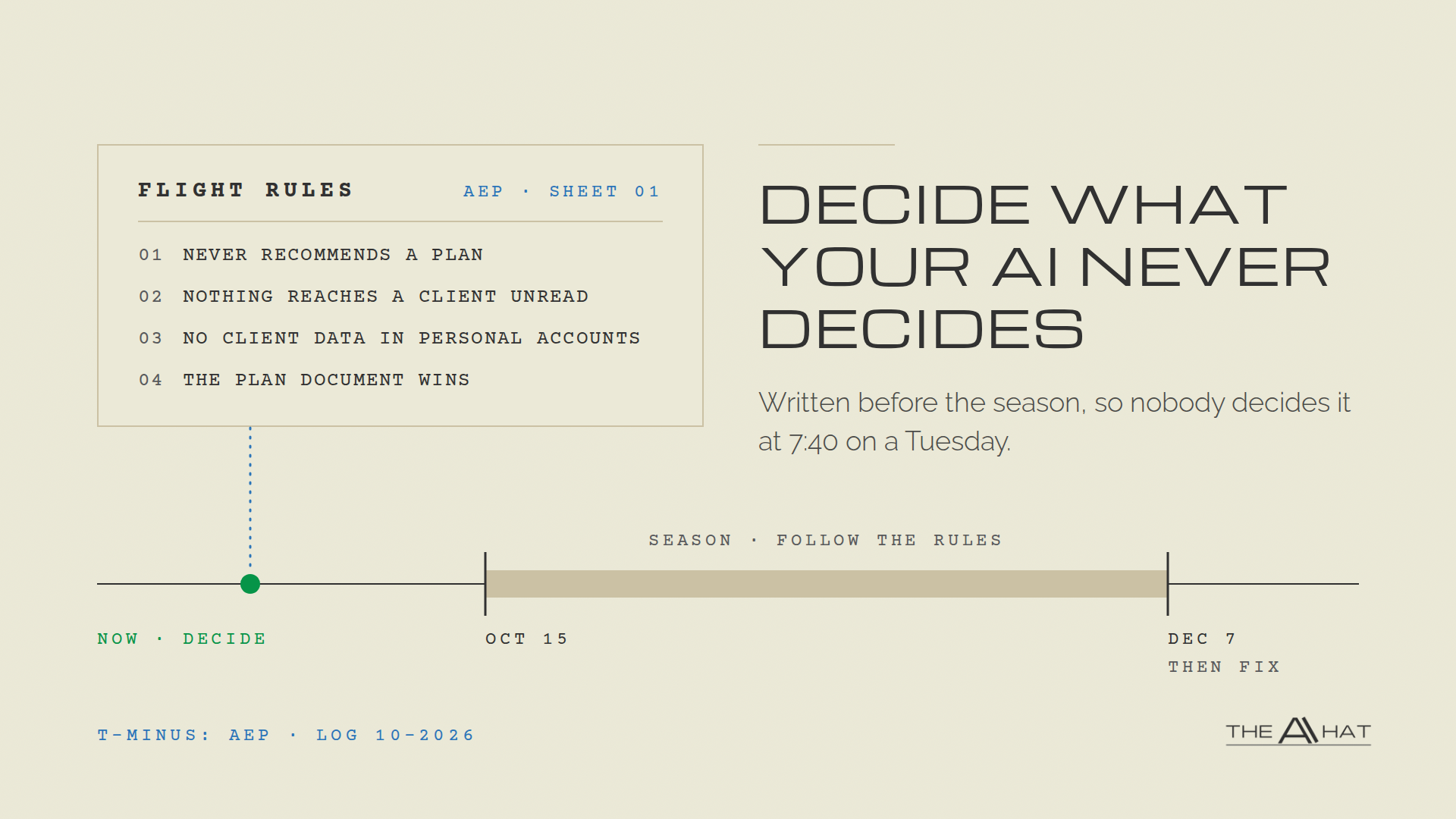
Let's be honest about the boundary. The recommendation is yours. The enrollment conversation is yours. The moment a client looks at you and asks "what would you do?" - no crew member touches that, and no crew member should. Everything above exists to clear the path to those moments, not to replace them. The agents who get this right don't hand off the relationship. They hand off everything that was keeping them from it.
Your countdown to October 15
Work backward from opening day.
By Labor Day: your Scribe is built and running on real material. You've produced at least ten follow-up documents with it, and reviewing them feels fast.
By late September: your Scout is live for ANOC season. The letters are arriving, the calls are starting, and you're answering plan-change questions from prepared summaries instead of raw documents.
By October 1: dress rehearsal. Run the full crew - morning briefings, appointment documentation, research support - on your real workload for two weeks. Find the failure points while a failure costs you an hour instead of a client.
October 15: the season opens. You're not experimenting. You're operating.
The agents who own their October are deciding right now, in August. The ones who don't will be at their desks at 9:40 on a Tuesday night, doing work a crew should have taken off their hands two months earlier.
If that first scene read less like a story and more like a memory, take ten minutes with the AI Adoption Reality Check. It will show you exactly where your agency sits today and which build to start with. Ten minutes in August is the cheapest hour you'll ever buy back in October.
Frequently asked questions
When should Medicare agents start preparing for AEP with AI?
August, or early September at the latest. Building an AI workflow reliably takes several iterations over four to eight weeks, and the Annual Notice of Change season in late September is the first live test. Agents who start after ANOC letters arrive end up building during the exact crunch the build was meant to relieve.
What can AI actually handle during AEP?
Documentation drafts, follow-up letters, to-do capture, plan-change research summaries, client-history briefings, and appointment prep. Every client-facing output gets agent review before it goes anywhere, and research gets verified against the actual plan documents.
What should agents never hand to AI during enrollment season?
The recommendation and the enrollment conversation. Clients choose an agent because a person they trust is helping them with one of the biggest healthcare decisions they'll make. AI clears the administrative path to that conversation, but the conversation itself, and the judgment inside it, stays with the agent.