Count the tabs it takes to move one renewal. Management system, carrier portal, the other carrier portal, quoting platform, email chasing a loss run, Teams because service needs you right now, back into the CRM to log it, then a spreadsheet because the thing the client actually asked for isn’t a report anywhere. That is eight, and not one of them is the conversation with the client. Nobody designed it that way. Nobody approved it. And you are paying your most expensive person to do it.
Every conversation about how to increase insurance agent productivity starts in the wrong place. It starts with tools. Which quoting platform, which AMS, which AI assistant. But the hours your producers lose are not sitting inside any one of those systems. They are sitting in the gaps between them, in the handoffs where a licensed professional stops working and starts carrying information from one place to another. That is where the week goes, and it is the one thing a new subscription has never fixed.
Listen to this episode
Watch on YouTube


The most expensive integration software in your agency isn’t software
Here is the line from the episode that people will either nod at or argue with:
The most expensive piece of integration software in your agency is a licensed producer.
Nobody bought it. Nobody approved it. There is no contract, no line item, no renewal date, and no vendor to call when it breaks. It runs every single day, all day.
Your management system cannot talk to the carrier portal. The portal cannot talk to the quoting platform. The quoting platform has never heard of your CRM. So a licensed insurance professional gets up every morning and manually connects them, one call at a time, all day long. That switching is not a workflow. It is an integration project nobody budgeted for, executed by hand, by whoever you pay the most.
There is a name for this cost, and it is not mine. It is the Toggle Tax, and Harvard Business Review put real research behind it in 2022. I wrote the whole thing up separately, including the numbers and where they came from, so I am not going to re-argue it here. What I will say is that the research followed internal teams, and my read is that a producer with a client on hold is paying more than the study measured, not less.
For seventy years, if you wanted to call somebody, a person had to physically connect you. A woman sat at a board with a couple hundred holes in it and plugged your line into their line. Skilled work, and they were fast, and they were good at it. Nobody ever fixed that by buying a nicer switchboard. Bigger boards got built, faster boards, more holes, and every improvement made her better at a job that should not have existed. What eventually changed it was somebody asking a different question: why is a person in the middle of this at all?
That is where your producers are. They are the cable.
Why the AI you bought made the day longer
At some point in the last year or two you did the reasonable thing and went and got some AI. Everybody did. I did. And the day got longer.
This is not an argument against the tools. They are remarkable and I use them constantly. But look at what actually happened when they arrived. Most agents I meet are already running two or three of them, usually on free accounts nobody approved and nobody is tracking. A general assistant open in a tab. A second one inside the document editor that showed up with the license. The carrier has one now, right there in the portal. Somebody in marketing started using a fourth and has not mentioned it to anyone. That is four or five new places to go, and not one of them replaced anything.
Then there is the part that catches people. The new switches cost more than the old ones.
When you go from email to a spreadsheet, everything you need is already in your head. You know which client, which renewal, which number you were chasing. You sit down and you go. A second, maybe two. Go to an AI tool and you have to say all of it out loud. Who the client is. What the plan covers. What you tried last week. What tone the email needs. Why any of it matters. That is minutes, every time, briefing a stranger who forgets every word the moment you close the tab. Then the next tool. Then tomorrow, same client, same speech.
You didn’t get an assistant. You got another line on the switchboard.
The obvious objection is memory. They all have memory now, so why is this still a problem? Because the memory these tools carry is good at your preferences and weak on your situations. It knows you work in insurance and hate bullet points. It does not know this client, this renewal, what the carrier rep said Tuesday, or what you already ruled out and why. And that is precisely the material that changes every week, which means it is the material you retype. Worse, whatever memory you have built lives in one tool, in one account, and you have four open. Four separate memories that have never met each other and never will.
This is the same failure pattern behind Pilot Purgatory: the tool works in the demo, the tool works in the pilot, and six months later the work has not changed. It is also the whole reason I keep saying AI belongs on your org chart, not your tech stack. A tool gets adopted. A seat gets held accountable.
Count, Name, Seat
Three steps, and the order carries the weight. Most people start at step three and then wonder why it did not stick.
Step one: count
Pick one recurring piece of work. Not your week. One job. A renewal, a proposal, onboarding somebody new. Count the switches it takes, start to finish. That is the whole step.
Three ways people botch it, and I have watched all three.
Do not count from memory. Do it live, on the next real one. Your memory of a renewal is smooth and tidy and about half the length of the actual thing, because the switches you have done ten thousand times have gone invisible to you. You have to catch them in the act.
Count switches, not minutes. People want to time themselves because timing feels more scientific, and it hides exactly what you are after. A twenty-second switch that wrecks your concentration costs more than four minutes of focused work. You are not measuring how long. You are measuring how many times you had to put something down and pick it back up.
And count the human ones. Getting up to ask a colleague is a switch. Slacking somebody and waiting is a switch. Putting a client on hold to go find something is absolutely a switch, and it is usually the priciest one you have. People leave those off because they do not feel like software.
The number comes in higher than people guess, and that surprise is doing real work. Up until then all you have is a feeling that the week is too full and you cannot say why. Feelings are very hard to fix. A number you can do something with.
Step two: name
Out of all those switches you are hunting one specific thing. Not the most frequent one. Not the one that irritates you the most. The one where the most context has to get rebuilt from nothing.
Here is something I have noticed running these sessions all year. When I ask a room of agents to name the task that feels most like data entry instead of selling, almost everybody says the same thing. Updating the CRM. Logging the call. Keeping the system current. It comes up first, it comes up fast, and it comes up nearly every time.
Then I ask a different question. What did you stop and go look up in the middle of a client call last week? What made you put somebody on hold, or say let me check on that and get back to you?
Nobody says the CRM.
They say plan specs. Whether a drug is on the formulary. Whether that doctor is still in network. What a carrier’s eligibility rules are for somebody dual eligible. What this plan covers compared to the one they had last year. Two questions, two completely different answers, same people, same room, ninety seconds apart.
That gap is the whole thing. Updating the CRM is tedious, but everything you need is already in your head while you are doing it. You are transcribing. Boring and expensive are not the same animal. The mid-call lookup is different work entirely: you are carrying the whole client situation into a system that has never heard of them, getting an answer, and carrying it back out, with somebody waiting on the phone.
Frequency is not cost. Context is cost.
Almost nobody picks the right one on instinct. Which is exactly why step one is count and not guess.
Step three: seat
Once you know which handoff is costing you, you give that context somewhere to live that is not a person’s short-term memory. That is what a Digital Crew is. Not another tab. A few assistants, governed, with defined jobs, holding context so nobody has to rebuild it every time they move.
Three shapes worth knowing, and each one kills a different switch.
Scout goes and finds things. Scout kills the go-and-look-it-up switch. Three portals, two logins, one answer, and it lands while your client is still on the phone instead of after you have had to call them back.
Scribe writes things down where they belong. Scribe kills the now-log-it switch. The work already happened. Recording it should not cost a second performance.
Coach gets you ready. Coach kills the rebuild-before-the-meeting switch. The brief is sitting there before you sit down, so nobody is skimming a file in the parking lot.
Building one is smaller than people expect. Start with one, not three. You are not coding and you are not buying. You are configuring an assistant and handing it the context you carry in your head every single time. For a Scout aimed at plan lookups, that means which carriers you actually write, where the current documents live, what a good answer looks like next to a useless one, and what it should say when it does not know. That last one is not optional.
Then use it on something real and watch where it is wrong. It will be wrong. Every wrong answer is pointing at something you know and never wrote down, and getting that out of your head is the actual work. Structuring what you hand it is most of the battle, which is why I teach the PRICE framework for exactly this.
You’re not chasing perfect. You’re chasing: this beats me doing it from scratch while somebody waits.
Which brings me to the thing I say in every room I stand in. Redesign the work before you deploy AI. Bolt AI onto a workflow that is already leaking hours to switching and you have not closed the leak. You have added taps.
The three rails, before any client data goes near an assistant
I spent most of that episode telling you to hand client context to an AI tool, and in this business that sentence has a rail on it.
Mike Welker manages benefits at a multi-line agency in Utah. He built his first AI assistant in one of my sessions back in May, and what he did afterward is why I keep telling people about him. Over roughly sixty days and four or five attempts, he built a workflow that pulls production and cancellation reports from every carrier he deals with, standardizes them into one format, masks the protected health information before anything leaves his machine, restores it locally, and drops the whole thing into one dashboard his team uses daily.
Four or five attempts. Not one clean build. That matters more than the result, because if you tried this and it flopped, you are not behind. You are on schedule.
He has not tracked the hours and I am not going to invent a number for him. What I can tell you is what stopped. He stopped being the cable between every carrier he works with.
Now notice what he built in from the start. The masking was not bolted on later when somebody complained. It was in the design. That is the bar, and I raise it because when I ask rooms what they are using, a lot of hands go up for free consumer accounts and personal logins that nobody approved and nobody is tracking. I understand exactly how that happens. The company tool is slow, or there is not one, or you needed an answer at nine at night and you are a person with a job. Nobody is a villain here. But the plain version is this: client health information does not go into a personal AI account. Not once. Not to test it. Not just this time.
Three rails, none of them complicated.
Know where the data goes. There is a real difference between a business account with terms attached and a free login. If you cannot say where your client’s information ends up, you are not ready to put it there.
Mask what is sensitive. You almost never need the client’s name and identifiers to get a useful answer about a plan or a rule. You need the situation, not the identity.
A human signs off on anything client-facing. Every time. The assistant drafts, you decide. That one sentence answers most compliance objections before anybody raises them.
And telling an assistant what to do when it is unsure is a governance decision, not a technical one. An assistant that says I don’t have that, go check the carrier is worth ten that guess with confidence. In this business, a confident wrong answer is the expensive kind of wrong. If governance is the part of this that worries you, start with the Shadow AI Launchpad and the growing pile of carrier-side questions in ISO’s new AI exclusions and whether your own insurance actually covers your AI.
None of this slows you down. It is about ten minutes of thinking, once, at the front.
What to do Monday, by seat
Pick one recurring job and count. That is the assignment. Not buying anything, not launching anything.
Producers. Take the renewal from the top of this post and count it live on the next real one. When you get to step two, resist the CRM. I know how much the logging bothers you. The first seat goes to the mid-call lookup: plan details, formulary, network, eligibility. That is Scout, and it is the one your client can hear the difference on.
Agency principals. Same count, different question in your head. You are not hunting a productivity number for a slide. You are looking at what your most expensive people spend hours on, hours you are already paying for. Count one producer’s renewal, then look at your book and do that multiplication. And settle the data question before anybody builds anything, because if you do not set that rail, somebody sets it for you by accident.
Sales outside insurance. CRM, enablement library, email, deal room, forecast sheet. Your priciest switch is almost always meeting prep. That is Coach.
Marketing. Brief, asset library, analytics, scheduler, approval thread. The priciest switch is the handoff into approvals. That is Scribe.
One warning, because I know where most people go first. Do not start by consolidating your stack. Every vendor alive will tell you the answer is fewer tools and theirs is the one worth keeping. But you do not control the carrier portals. You do not control the compliance system. Most of your toggle set was picked by people who do not work for you and will never take your call. Tool count is not the lever you have. The handoff is.
Go back to those eight tabs. Every one of them is a place where two systems could not reach each other, so a person got up and connected them by hand. Eight times, for one renewal, and there is another renewal after that one.
You weren’t hired to be the cable.
Neither were your producers. Somewhere along the line the job quietly picked up a second job, and nobody wrote it down and nobody ever paid anyone for it. You can give that second job back. Not all at once, and not by buying a platform. One handoff at a time, starting with whichever one costs you the most. But you have to know which one that is, which is why you count first.
Your next step
If you want a faster read on where your organization stands right now, take the AI Adoption Reality Check. Six questions, about five minutes, and rather than handing you a generic score it names the one gap holding you back and what to do about it.
About the host
Mike Allton is a practitioner, not a futurist. As Director of Partner-Led Growth at Agorapulse and host of The AI Hat Podcast, he helps teams clear the Admin Drag burying their best people, redesigning the work first and then building a Digital Crew of AI agents to take the busywork. Whether you sell, serve, or build, the drag is the same.
Resources mentioned
- What Is the Toggle Tax? – the definition, the Harvard Business Review research, and where the numbers come from
- What Is Admin Drag? – the villain behind all of this
- What Is Pilot Purgatory?
- The AI Adoption Reality Check – the episode’s one ask
- The Shadow AI Launchpad
- The PRICE Framework
- AI Belongs on Your Org Chart, Not Your Tech Stack
Chapters
- 00:00 Count the tabs it takes to move one renewal
- 01:36 The Toggle Tax, and why the name isn’t mine
- 02:42 Your most expensive integration software is a licensed producer
- 03:03 The switchboard operator problem
- 04:16 You bought the AI. The day got longer.
- 05:09 Why AI switches cost more than the old ones
- 05:54 “But it remembers things now”
- 07:13 Two hours of prep I dreaded, and the GPT that ended it
- 09:44 The hard part: you’re good at this
- 10:27 How Mike Welker stopped being the cable
- 11:34 The framework: Count, Name, Seat
- 11:49 Step one, Count, and the three ways people botch it
- 13:30 Step two, Name: frequency is not cost, context is cost
- 15:22 Step three, Seat: Scout, Scribe, and Coach
- 16:26 What building your first assistant actually looks like
- 17:35 The three rails before client data goes anywhere
- 19:41 “Compliance will never let me,” and three other objections
- 22:03 What to do Monday, by seat
- 23:52 You weren’t hired to be the cable
- 24:31 The AI Adoption Reality Check

Full transcript
Read the full episode transcript
Count the tabs it takes to move one renewal. Go ahead. I'll wait. Management system, carrier portal, the other carrier portal, quoting platform, email, chasing a loss run, Teams because service needs you right now, back to the CRM to log it, then a spreadsheet because the thing your client actually asked for isn't a report anywhere.
That's eight. Your client heard all eight of those, by the way. They heard you typing. They heard the pause. They heard you say, "Let me check on that and get back to you." Nobody designed it this way. Nobody approved it. And you're paying your most expensive person to do it.
Greetings program. Welcome back to the AI Hat Podcast.
I'm Mike Allton. So I've been sitting on this one for a while 'cause it took me a long time to figure out what I was even looking at. I walk into agencies, good ones, well-run, smart people, nobody slacking, and everyone's exhausted in a way that doesn't match the work. When I ask what's eating the weak, nobody can point at it.
It's never one thing. It's never the thing on the calendar. Took me most of a year to name it and then a while longer to notice something worse, which is that a lot of the agencies who went out and bought AI to fix it made it measurably worse, not through any fault of their own.
Nobody told them what was going to happen. So that's today. What's eating your week? Why the AI made it heavier instead of lighter, and three things you can run Monday morning without spending a dollar.
There's a name for what you just counted, and it isn't mine. I want to be clear about that from up front.
It's the Toggle Tax, what costs you to keep switching between the systems your work is spread across. Harvard Business Review put real research behind it back in twenty twenty-two. They tracked people across a few big companies and clocked them switching between applications something like twelve hundred times a day.
Twelve hundred.
And any one of those switches only costs you a second or two of getting your bearings, which is the whole reason no one's ever complained about it in a staff meeting. Who's going to file a grievance over two seconds?
One caveat, and I'd rather give it to you than have you find it later.
That study looked at back-office teams, finance, HR, supply chain, not producers. Nobody with a human being on hold. So twelve hundred isn't your number. Twelve hundred is your floor. I wrote all that up over at theaihat.com if you want the research. That post is where the definition lives. I'm not spending this episode defining a term for you.
What I want to talk about is what it's costing you, and I'll just say the thing. The most expensive piece of integration software in your agency is a licensed producer. Nobody bought it. Nobody approved it. There's no contract, no line item, no renewal date, no vendor to yell at when it breaks, and it runs every single day, all day.
That switching isn't a workflow. It's an integration project nobody budgeted for, executed by hand or whoever you pay the most. Let me put it another way because I think there's a better picture for this. For about seventy years, if you wanted to call somebody, a person had to physically connect you.
There was a woman sitting at a board with a couple hundred holes in it, and she'd take a cable and plug your line into their line. That was the job. Thousands of them all over the country. Skilled work, and they were fast, and they were good. Now, nobody ever fixed that by buying a nicer switchboard Bigger boards got built, faster boards, more holes, and every improvement made her better at a job that shouldn't have existed.
What eventually changed it was somebody asking a different question, which was, "Why is a person in the middle of this at all?" That's where you are. You're the cable.
Your management system can't talk to the carrier portal. The portal can't talk to the quoting platform. The quoting platform has never heard of your CRM, so a licensed insurance professional gets up every morning and manually connects them one call at a time all day long.
And you're good at it. That's not a compliment exactly. Hold on to that. I'm coming back to it. So at some point in the last year or two, you did the reasonable thing and went and got some AI. Everybody did. I did. And the day got longer.
Now, I'm not down on the tools. Let me kill that idea before it starts.
They're remarkable. I use them constantly. My business would be at a fraction of its size without them. But look at what happened when they arrived. Most agents I meet are running two or three of these already, usually on free accounts nobody approved and nobody's tracking. There's a general assistant open in a tab.
There's a second one inside the document editor that showed up with the license and nobody asked for. The carrier's got one now right there in the portal. Somebody in marketing started using a fourth and hasn't mentioned it to anyone. Four or five new places to go, and not one of them replaced anything.
And the new switches are more expensive than the old ones, which is the part that catches people. When you go from email to a spreadsheet, everything you already need is already in your head. You know which client, which renewal, which number you're chasing. You sit down, you go. Second, maybe two. Go to an AI tool, and you have to say all of it out loud.
Who the client is, what the plan covers, what you tried last week, what tone the email needs, why any of this matters, what you're even trying to do. That's minutes every time. Briefing a stranger who's going to forget every word the second you close the tab. And the next tool, the same thing. And tomorrow, same client, same speech.
You didn't get an assistant. You got another line on the switchboard.
Some of you are ahead of me right now going, "Hang on. Mine remembers things. They all have memory now. Why is this still a problem?" Well, that's a good question, a fair question, and the answer matters for step three later. So stay with me.
Most of these do have memory of some kind, and it genuinely helps. It's just narrower than people think. Memory's pretty good at your preferences, how you like things written, that you work in insurance, that you hate bullet points. Fine. Useful. Saves you some repeating. It's much weaker on your situations.
This client, this renewal, what the carrier rep said Tuesday, what you already ruled out and why, and that's the stuff that changes every week, which means that's the stuff you retype. Bigger problem. Whatever memory you built lives in one tool in one account. You've got four open. Four separate memories that have never met each other, don't share anything, never will.
So now you're carrying context between four systems and four assistants, each one certain it knows you, none of them knowing this client. More holes in the board One more thing, then I'll move on, and I'm gonna leave it sitting there for a while. The switch that's costing you the most is not the one you're about to guess.
I'll come back to it. But here's how I learned this, and it wasn't in an agency. It was on my own calendar, and it was kinda ugly. When I was getting the podcast going, prep for one interview ran me about two hours. Researching the guest, reading what they'd written, working out what I wanted to ask, building the pre-show doc so we didn't wander into nowhere for 40 minutes.
Two hours every episode, and I hated it. I wanna be honest 'cause I, I think people assume this has always come easy to me. It was the task I put off until the last possible second every time, which meant I was doing my best thinking about a guest at 10 o'clock the night before, which is not when anybody does their best thinking.
Sometimes a guest cancels. Happens. Nobody's fault. Two hours gone. And I'll tell you something I don't bring up much. I've quit podcasts before. My first two shows never made it past a dozen episodes, not because nobody was listening and not because the content was bad, because the friction around them grounded me down until I stopped That sat with me as a failure for a long time.
So the first custom GPT I ever built wasn't strategic. I wasn't executing a vision. I was trying not to quit again. I gave it what I knew, how I research a guest, what separates a good question from a lazy one, what the pre-show doc needs in it to be worth anything, and I rebuilt it more than once because version one was rough.
But two hours turned into about twenty minutes. Twenty minutes isn't just a smaller number though. It changed the shape of what I could take on. At twenty minutes, I can sit down Monday afternoon and prep a whole week in one go while my head's already there, which is the only reason I could go from one podcast to three and then five for Agorapulse, each one aimed at a completely different audience, plus my own show on top.
Most of last year, I was running five shows, thirty-six plus episodes a quarter. At the old rate, that's north of, I don't know, sixty-two hours of prep in a quarter. Came down to about twelve. But the hours are the boring part. Look at what those hours were. Sixty-two hours a quarter isn't a task I trimmed.
It's a job I couldn't have said yes to. There's no version of me running five podcasts at two hours a show. That business doesn't exist. The ceiling wasn't ambition. It was arithmetic. That's what this does when it works. Doesn't hand you a tidier Thursday. It changes what you're allowed to want.
Now, I owe you the thing I said I'd come back to. You're good at this. You've built workarounds. You know which portal is slow in the mornings. You keep a text file of plan details because pulling them up takes four clicks. You've got a whole system for remembering what you can't look up fast enough. That competence is real, and it's why nothing changes.
Every clever workaround you invent makes a broken design survivable, and a broken design that's survivable never gets fixed. It just gets absorbed by you. Nobody ever built a better switchboard because the operators were struggling. They kept building them because the operators kept coping. I'm not asking you to stop being good at your job.
I'm asking you to stop being the reason nobody notices it's broken. Let me give you the agency version because I don't want you thinking this only works for some guy with a podcast. There's a gentleman named Mike Welker, manages benefits at an agency out in Utah. He was sitting in one of my sessions back in May and built his first AI assistant right there in the room.
What he did afterwards is why I'm telling you about him. Over about sixty days, four or five attempts, he built a workflow that goes out and pulls production and cancellation reports from every carrier he deals with, standardizes them into one format, masks the protected health information before anything leaves his machine, and then puts it back locally.
Drops the whole thing into one dashboard his team uses every day. Four or five attempts, not one clean build. Honestly, I think that matters more than the result 'cause if you tried this and it flopped, you're not behind, you're on schedule. He hasn't tracked the hours, and I'm not gonna invent a number for him.
What I can tell you is what it stopped. He stopped being the cable between every carrier he works with.
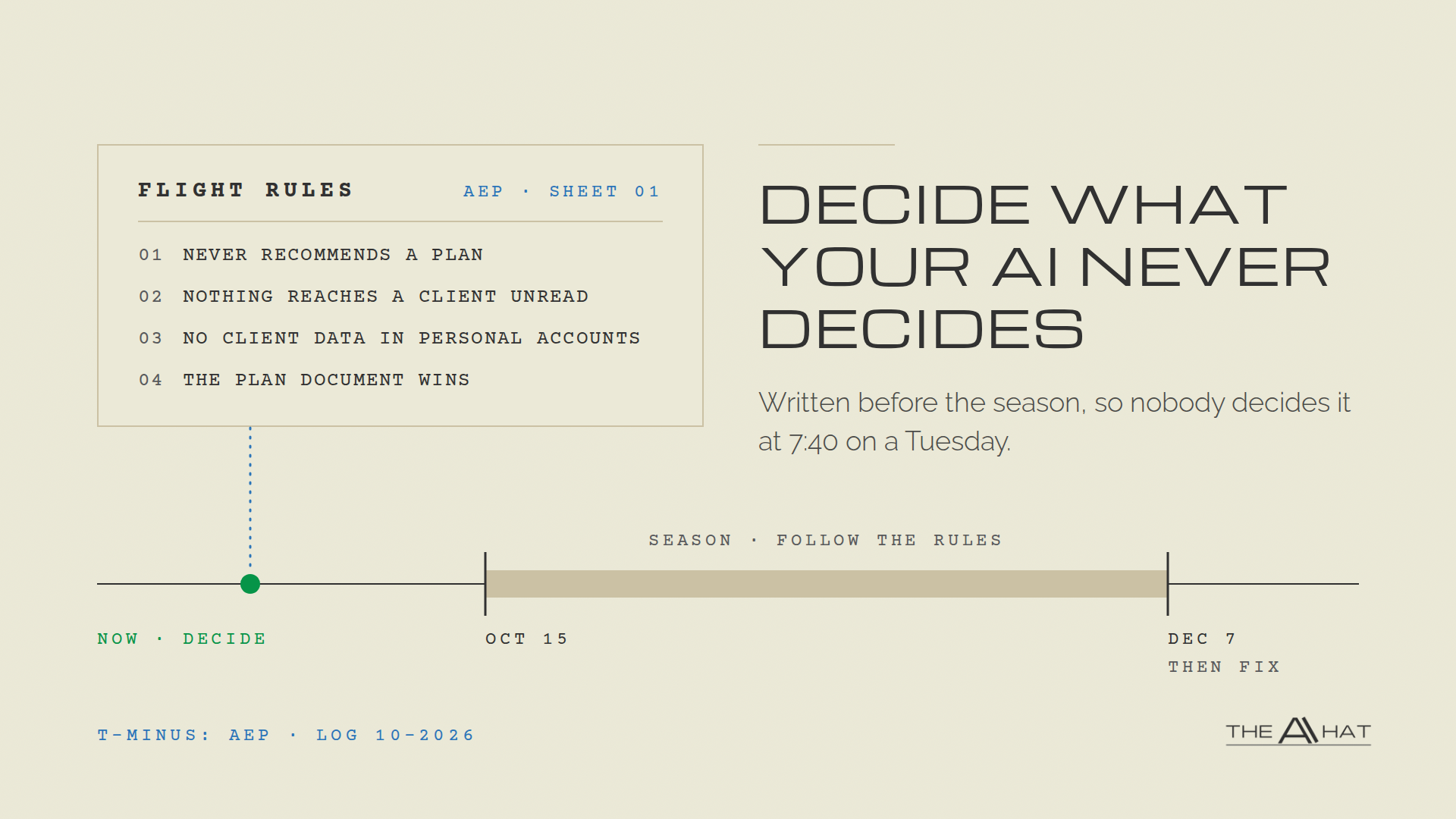
All right. Monday morning, what do you do? Three steps: count, name, seat. Count, name, seat. Now, the order matters, and I say that because most people start at the seat, number three, and then wonder why it didn't stick.
So step one, count. One recurring piece of work. Not your week. I'm not asking you to audit your life. One job, a renewal, a proposal, onboarding somebody new, something you could probably describe in your sleep. Count the switches it takes start to finish. That's the whole step. Now, let me save you from the three ways people botch it because I've watched all three.
Number one, don't count from memory. Do it live on the next real one. Your memory of a renewal is smooth and tidy and about half the length of the thing itself. The switches you've done ten thousand times have gone invisible to you. You have to catch them in the act
Number two, count switches, not minutes.
People wanna time themselves because timing feels more scientific. It hides what you're after. A 20-second switch that wrecks your concentration costs more than four minutes of focused work. You're not measuring how long. You're measuring how many times you had to put something down and pick it back up again.
And count the human ones. Getting up to ask a colleague is a switch. Slacking somebody and waiting is a switch. Putting a client on hold to go find something is absolutely a switch, and it's usually the priciest one you've got. People leave those off 'cause they don't feel like software. But here's what happens when you do it right, and it happens nearly every time.
The number is higher than people guess, not a little. Somebody says four, and it comes in at nine. That surprise is doing work. Up until then, all you have is a feeling, a vague sense the week is too full, and you can't say why. Feelings are very hard to fix. A number? Well, you can do something with that.
Step two: name.
And this is where I come back to what I left hanging. Out of all those switches, you're hunting one specific thing, not the most frequent one, not the one that irritates you the most, the one where the most context has to get rebuilt from nothing. Here's something I've noticed running these sessions all year.
When I ask a room of agents to name the task that feels most like data entry instead of selling, almost everybody says the same thing: updating the CRM. Logging the call, keeping the system current. Comes up first, comes up fast, comes up nearly every time. But then I ask a different question: What did you stop and go look up in the middle of a client call last week?
What made you put somebody on hold or say, "Let me check on that and get back to you"? Nobody says the CRM. They say plan specs, whether a drug's on the formulary, whether that doctor's still in-network, what a carrier's eligibility rules are for somebody dual eligible, what this plan covers compared to the one they had last year.
Two questions, two completely different answers. Same people, same room, ninety seconds apart.
That gap is the whole thing. Updating the CRM is tedious, but everything you need is already in your head while you're doing it. You're transcribing. Boring? Sure. Boring and expensive aren't the same animal. The mid-call lookup is different work entirely.
You're carrying the whole client situation into a system that's never heard of them, getting an answer, carrying it back out with somebody waiting on the phone. Frequency is not cost. Context is cost. And almost nobody picks the right one on instinct, which is exactly why step one is count and not guess.
Step three: seat. Once you know which handoff is costing you, you give that context somewhere to live that isn't a person's short-term memory. That's what I mean by Digital Crew, and I don't mean another tab. I mean a few assistants governed with actual defined jobs, holding context, so nobody has to rebuild it every time they move.
Three shapes worth knowing, and each one kills a different switch. The first is scout. Scout goes and find things. Scout kills the go look it up switch. Three portals, two logins, one answer, and it lands while your client's still on the phone instead of after you've had to call them back.
The scribe writes things down where they belong.
Scribe kills the now log it switch. The work already happened. Recording it shouldn't cost you a second performance.
The coach gets you ready. Coach kills the rebuild before the meeting switch. Brief's sitting there before you sit down, so you're not skimming a file in the parking lot two minutes out.
What does building one look like? Well, I don't want to leave that floating. First, start with one, not three. One of these seats. You're not coding. You're not buying. You're configuring assistant and handing it the context you carry in your head every single time.
For a scout aimed at plan lookups, which carriers you actually write, where the current documents live, what a good answer looks like next to a useless one, and what it should say when it doesn't know. That last point's not optional. I'll come back to it in a second. Then use it on something real and watch where it's wrong.
It will be wrong. Welker took four or five passes, and he's sharper at this than most people I meet. Every wrong answer is pointing at something you know and never wrote down, and getting that out of your head is the actual work. You're not chasing perfect. You're chasing, "This beats me doing it from scratch while somebody waits
Which brings me to the thing I say in every room I stand in, so I'll say it here.
Redesign the work before you deploy AI. Bolt AI onto a workflow that's already leaking hours to switching, and you haven't closed the leak, you've added taps.
Now I have to stop because I've spent almost twenty minutes telling you to hand client context to an AI tool, and in our business, that sentence has a rail on it.
Go back to Welker a second. Notice what he built in from the start. Mask the protected health information before anything leaves his machine, restores it after. That wasn't bolted on later when somebody complained. It was in the design. That's the bar, and I raise it because when I ask rooms what they're using, a lot of hands go up for free consumer accounts, personal logins.
Nobody approved it. Nobody's tracking it. And in plenty of cases, nobody at the agency knows it's happening. And I get exactly how that happens. The company tool is slow, or there isn't one, or you needed an answer at nine at night, and you're a person with a job. Nobody's a villain here. But the plain version?
Client health information does not go into a personal AI account. Not once, not to test it, not just this time. So three rails, none complicated.
Know where the data goes. There's a real difference between a business account with terms attached and a free login. If you can't say where your client's information ends up, you're not ready to put it there.
Mask what's sensitive. That's Welker's move. You almost never need the client's name and identifiers to get a useful answer about a plan or a rule. You need the situation, not the identity.
And third, and this is important, a human signs off on anything client-facing every time. The assistant drafts, you decide.
That one sentence answers most compliance objections before anybody raises them. And remember what I said about telling it what to do when it's unsure? That's a governance decision, not a technical one. An assistant that says, "I don't have that. Go check the carrier," is worth ten that guess with confidence.
In this business, a confident wrong answer is the expensive kind of wrong. None of this slows you down. It's about ten minutes of thinking once at the front.
I've given this talk enough times to know what's coming, so let me take the four objections you probably have head-on.
Compliance will never let me.
Ask them. Really ask. What I find is most people never asked. They imagined the answer, and then they obeyed the answer they imagined. When somebody puts the real question in front of compliance, it's hardly ever a flat no. It's conditions. Where's that data live? Who reviews the output? What's off the table?
Those conditions, those are the three rails I just gave you. Walk in already meeting them, and you're not making a request anymore. You're bringing a proposal. Completely different room.
I don't have time to build this.
You know, this is the honest one, and it deserves better than a pep talk. You're right.
It takes time. Not weeks, but a few real hours across a few sittings, and you don't have a few spare hours. Nobody does. That's the entire problem we're discussing. But look at the shape of that trap. The reason you have no time is the thing you have no time to fix. That's true forever, unless somebody breaks it on purpose.
So I'll make it as small for you as I can. One assistant, one lookup. The single question you answer most often. Not a rollout, not a committee. One thing on one job.
I've tried it, and it made things up.
Yeah, it does. Anybody who tells you different is selling you something. But look at what you actually did.
You asked a general-purpose assistant a specialist question with none of your context loaded, no sources pointed at it, no instruction about what to do when it didn't know. It did the thing it's built to do, which is produce something plausible. The tool didn't fail. An unconfigured tool behaved normally.
The gap between that and what Welker built isn't a better product. It's the context and the guardrails he wrapped around it, which again, is why it took him four or five swings.
I'm not technical.
Almost none of what I've described is technical. There's no code anywhere in this. If you can explain your job to a new hire, you can configure an assistant.
Same skill, same document. And the hard part was never technical anyway. The hard part is what you know a hundred things about how you work that you've never written down once. Getting those out of your head, that's the job, and that's not engineering. It's just difficult in its own way.
So Monday morning, pick one recurring job and count.
That's the assignment. That's all of it. Not buying anything, not launching anything. Quick translation, because where you sit changes where you're gonna land. If you're a producer, take that renewal from the top of the show, count it live on the next real one, and when you get to step two, resist the CRM. I know how much the logging bothers you. First seat goes to the mid-call lookup, plan details, formulary, network Eligibility.
That's scout, and it's the one your client can hear the difference on.
Now, if you're running the agency, same count, different question in your head. You're not hunting a productivity number for a slide. You're looking at what your most expensive people spend hours on, hours you've already paid for. Count one producer's renewal, then look at your book and do that multiplication.
And settle the data question before anybody builds anything, because if you don't set that rail, somebody sets it for you by accident
If you're in sales outside of insurance, same shape: CRM, enablement library, email, deal room, forecast sheet. Your priciest switch is almost always meeting prep. That's your coach.
If you're marketing, hmm, brief, asset library, analytics, scheduler, approval thread. Priciest switch is probably that handoff into approvals. That's your scribe.
One warning, 'cause I know where most people go first. Don't start by consolidating your stack. I understand the pull. Every vendor alive will tell you the answer is fewer tools, and theirs is the one worth keeping, but you don't control the carrier portals.
You don't control the compliance system. Most of your toggle set got picked by people who don't work for you and will never take your call. Tool count isn't the lever you have. The handoff is.
Go back to those eight tabs for a second. Every one of them is a place where two systems couldn't reach each other, so a person got up and connected them by hand eight times for one renewal, and there's another renewal after that one.
You weren't hired to be the cable. Neither were your producers. Somewhere along the line, the job quietly picked up a second job, and nobody wrote it down, and nobody ever paid anyone for it. You can give that second job back, not all at once, and not by buying a platform, one handoff at a time, starting with whichever one costs you the most.
But you gotta know which one that is, which is why you count first.
If you want a faster read on where your organization stands right now, I built something for exactly that. It's called the AI Adoption Reality Check over at theaihat.com/reality-check. Six questions, about five minutes. And rather than handing you some generic score, it names the one gap holding you back and what to do about it.
It's free, linked in the show notes below, theaihat.com/reality-check.
That's the show. If this one landed, do me a favor and send it to whomever in your office has been drowning and can't quite explain why. I'm Mike Allton. Thanks for wearing the AI Hat with me. Welcome to the grid.