I have spent a good part of this year standing in front of rooms full of agency leaders. At the WAP Agency Leadership Summit in the spring, and again at the Kellogg Business Development Summit a few weeks later, I watched the same thing happen. Smart, successful people who have built real books of business would lean forward when the conversation turned to AI, and underneath the curiosity was a quiet frustration. They had tried. They had bought a tool, or sat through a webinar, or told the team to start using ChatGPT. And almost none of it had stuck.
If that sounds familiar, I want to be honest with you right up front. The problem was never you, and it was probably not the tool either. The problem is that the way our industry is being taught to adopt AI is built to fail.
This guide lays out what is actually happening inside independent agencies in 2026, why most AI training quietly falls apart, and the approach that produces results you can see in your numbers. No hype, no tour of shiny toys. Just the path I walk agencies down when they want AI to mean something on the P&L.
The state of AI in insurance agencies in 2026
Let's start with the honest picture, because it explains everything that follows.
A 2026 Big "I" Agents Council for Technology Tech Trends Report found that two-thirds of independent agencies plan to increase their AI use over the next year. That is the optimism. Here is the reality sitting right beside it: nearly a third are not using AI at all, and most of the ones who have started are still circling the early, experimental stages. Almost everyone intends to move. Very few have crossed over.
It gets sharper when you look beyond our own corner of the world. An MIT study of enterprise AI found that roughly 95% of AI pilots never produced a measurable impact on the bottom line. Not because the technology cannot deliver one, but because the way it was rolled out never gave it the chance. Intent runs high. Integration stays rare. That gap is the whole story.
And there is a human split underneath all of this that nobody likes to name. Your principals and owners tend to see AI as a survival issue. Your account managers and service staff are far more likely to see it as a threat to their seat. So leadership pushes, the team quietly resists, and the initiative dies in the gap between them.
None of that is a technology problem. Every bit of it is an adoption problem. Which is exactly why buying more technology has not fixed it.
Why generic AI training fails agents
Here is the thing almost no one selling AI training will tell you.
Most AI training teaches tools. It shows your team how to open ChatGPT, where to type, maybe a tidy list of prompts to copy. Everyone nods. A few people experiment for a week. Then the quarter gets busy, the renewals pile up, and the whole thing evaporates, because nothing about how the work actually moves through your agency ever changed.
Training your team on a tool is like handing them a faster car and never touching the road. The car is genuinely better. But if the road still has the same potholes, the same detours, the same toll booths, you do not arrive any sooner. You just have a nicer commute through the same traffic.
The work is the road. The tool is the car. Generic training obsesses over the car and ignores the road, and that is the entire reason it fails.
There is a second failure built in. One-and-done training treats adoption as an event. It is not. Adoption is a progression, and people move through it at different speeds. A two-hour session cannot carry a team from "I am nervous about this" all the way to "this is simply how we do renewals now." That takes a redesign of the work itself, supported over time, not a calendar invite and a slide deck.
So the place to start is the road. Before anyone picks a tool, find where the hours actually go in your agency: which jobs, which people, and how much of each week they eat. That tells you which stretch of road to fix first, and the rest of this guide is about fixing it.
What AI adoption actually looks like, role by role
Let me make this concrete, because "adopt AI" is uselessly vague. Adoption is not something your agency does in general. It is a set of specific jobs, done by specific people, made dramatically lighter. The industry shorthand I use for all that lost time is Distribution Drag, and real adoption is simply the disciplined work of removing it.
When I worked with the teams at those summits this spring, we did not talk about AI in the abstract. We built digital teammates for the actual roles in the room.
For the producers, we built what I call a Proposal Architect. Nobody got into insurance because they love assembling proposals. It is the part of the job that eats evenings. So we redesigned it. The producer brings the client situation, and the AI teammate drafts the comparison, the talking points, and the first version of the document, in minutes instead of hours. The producer keeps every bit of the judgment and the relationship. The drudgery just stops being theirs.
For the early-morning scramble of working out who to call and why, we built a Digital Intern. Imagine your team starting each day with a one-page briefing already waiting on every lead and every renewal, the research done overnight, so the first hour of the day goes to talking with people instead of preparing to talk with people.
We built sales coaches that role-play tough objections before the real call. We built partnership assistants that handle the research behind referral relationships. Different roles, same principle every single time. We did not add a tool and hope. We took one painful workflow and rebuilt it so the human did the human part and the machine did the rest.
That is what adoption looks like when it works. Not a subscription. A redesigned day.
Governance: the policy before the prompt
Now I have to be direct about the part most agencies skip until it frightens them.
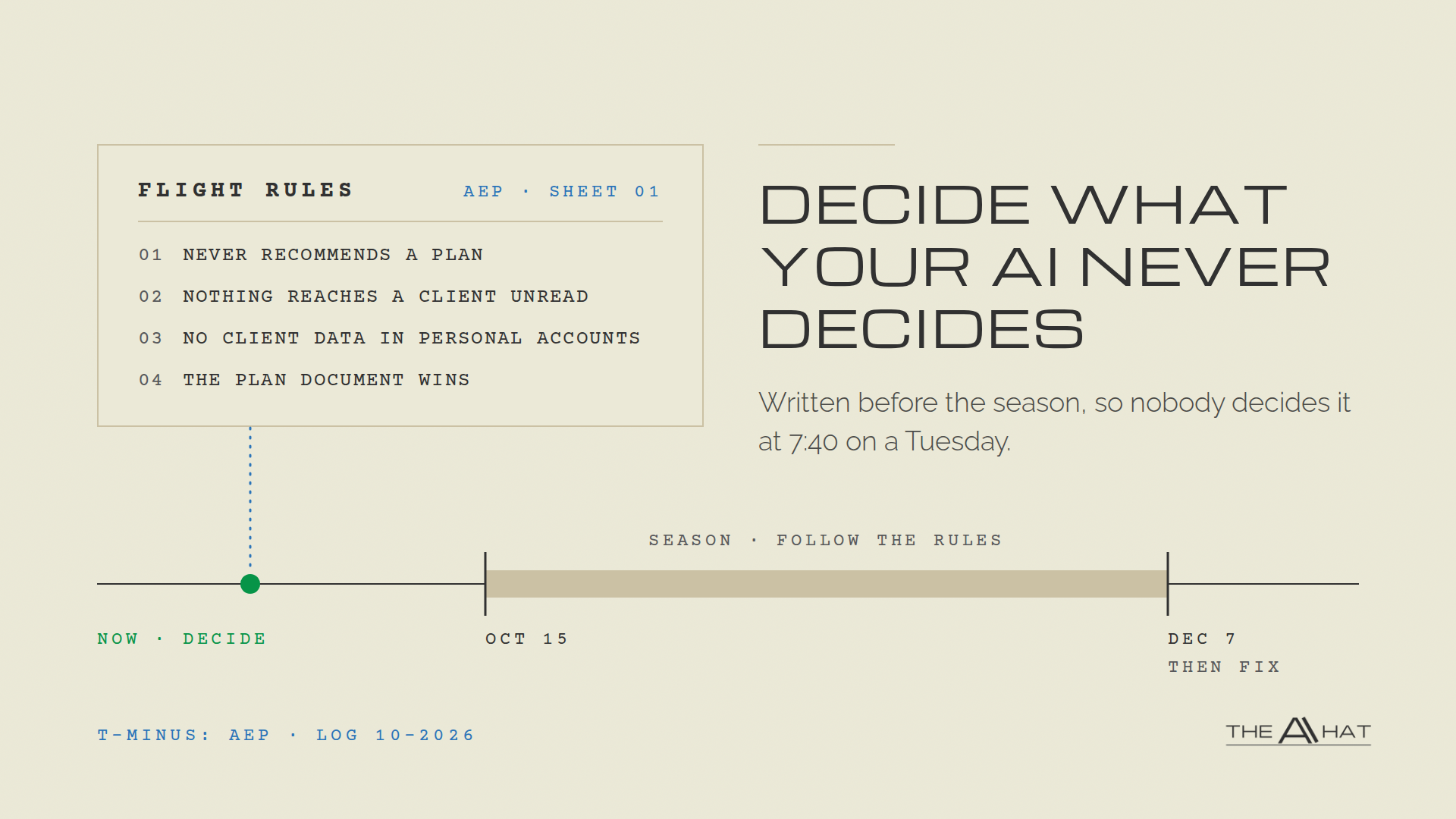
Your team is already using AI. Whether or not you approved it, whether or not you trained anyone, people are quietly pasting client information into personal accounts to get their work done faster. MIT's research found that workers at more than 90% of companies already do exactly this through personal accounts, while only about 40% of companies have bought sanctioned tools at all. That is Shadow AI, and in our business it is not only a productivity question. It is an Errors and Omissions question, and in the senior market it runs straight into Medicare marketing rules and call-recording requirements.
IBM's 2025 Cost of a Data Breach report found that 63% of organizations still have no AI governance policy, and that breaches involving heavy shadow AI ran about $670,000 higher on average. That is the exposure in one sentence. A client's information goes into a tool nobody vetted, and now you have a data and compliance problem you did not even know you owned.
Here is the reframe, and it matters. The answer is not to ban AI, because banning it only pushes the use deeper into the shadows. The answer is to bring it into the light. A clear, simple acceptable-use policy does not slow your team down. It is the very thing that lets you finally say yes safely, and scale what works without lying awake about it. Governed AI is faster AI, because it is the only kind you can confidently roll out to the whole agency.
How to actually start
If you take one thing from this guide, let it be the order of operations, because nearly everyone runs it backwards.
Do not start by buying a tool. Do not start by booking a training. Start by finding where the hours actually go, because that determines everything that should come next. Then pick one workflow, just one, the one bleeding the most time, and redesign it end to end. Prove it. Govern it. Then move to the next one.
That is the whole method. Diagnose, redesign one workflow, govern it, repeat. It is unglamorous, it is proven, and it is the opposite of the tour-the-tools-and-hope approach that has left so many agencies stuck.
Your people are not the problem. They are excellent at the part of this job that no machine will ever do, which is sitting with another human being through a decision that matters and making it feel manageable. Everything we are doing here exists to give them more room to do exactly that.
Frequently Asked Questions
No, and the framing misses the point. AI is very good at the rote work that surrounds the sale and very bad at the trust, judgment, and reassurance that is the sale. The agent who uses AI well will out-serve the agent who does not, but the human stays at the center. What gets replaced is the busywork, not the advisor.
Honestly, the tool is the last question, not the first. The right starting point is which workflow is costing you the most time, and what a redesigned version of it would look like. Choose the tool to fit that, never the other way around. Agencies that start with the tool end up in Tool Sprawl.
Not without a policy and the right setup. Personal consumer accounts are not the place for client information, and in the senior market that can create both E&O and compliance exposure. It is very solvable, but it has to be deliberate, which is exactly what an acceptable-use policy is for.
Lead with the workflow, not the software. Training that teaches a tool fades within a week. Training built around a redesigned process your team uses every day is the kind that sticks, because the new way of working becomes the training.
Faster than most leaders expect on a single workflow, and longer than the hype suggests across the whole agency. One redesigned workflow can show time back almost immediately. Becoming a fully operationalized agency is a progression measured in quarters, not days.
Where to go from here
If you'd like to see where your team's hours are actually going before you change anything, take the AI Opportunity Score. It takes about three minutes, shows you how many hours a week your team could get back, and gets you a starter crew member built for the biggest one.
And when you are ready to put this in front of your team or your members, building the actual digital teammates for the actual roles in the room is the work I do in agency workshops and at events like the ones this spring. If that is the conversation you want to have, https://theaihat.com/speaking/ is where to start.