Watch a NASCAR pit stop and the speed is the first thing you notice. The thing worth noticing is that nobody hesitates. The jackman lifts the car, the tire changers each take a side, the fueler fuels, and not one of them looks around to ask whose turn it is. Every job was assigned long before the car came down pit road. The air guns help, but every crew on pit road has air guns.
Most agencies shop for AI the other way around. Someone sees a demo of a tool that writes the monthly report, the agency buys a seat for everyone, and a month later three account managers are using it three different ways while a fourth still builds the deck by hand. The tool works fine. Nobody decided whose job it was.
So there's no ranked list here. Product names change every quarter, and the tool matters less than which part of your month it takes over and who on your team owns it. What follows is four stretches of an agency's month where AI earns its keep, the kind of tool each one needs, and what to settle before client material goes anywhere near it. For the bigger picture of how an agency rebuilds its month around a governed Digital Crew, that's on the AI for marketing agencies page. This post is about the tools.
Every client brings its own dashboards, guides and voice
Most tool roundups are written for a marketer working alone. An agency is a different shape. Every client has a brand guide, a set of dashboards, a Slack channel and an idea of what a good month looks like. A tool that saves one account manager an hour can cost the agency more than that if it adds one more place to check for every client. That's the Toggle Tax, the cost of switching between systems, and in an agency it gets multiplied by the client list.
The other cost is consistency. When everyone uses AI their own way, the client hears a different voice depending on who wrote this week's email. I used to spend hours going back and forth with AI trying to get a draft to sound like me, and it only started working once I handed it samples of my own best writing to learn from. Most agencies skip that step for every client they serve, then wonder why the drafts read like the internet's average.
Four stretches of an agency's month, and the tool each one needs
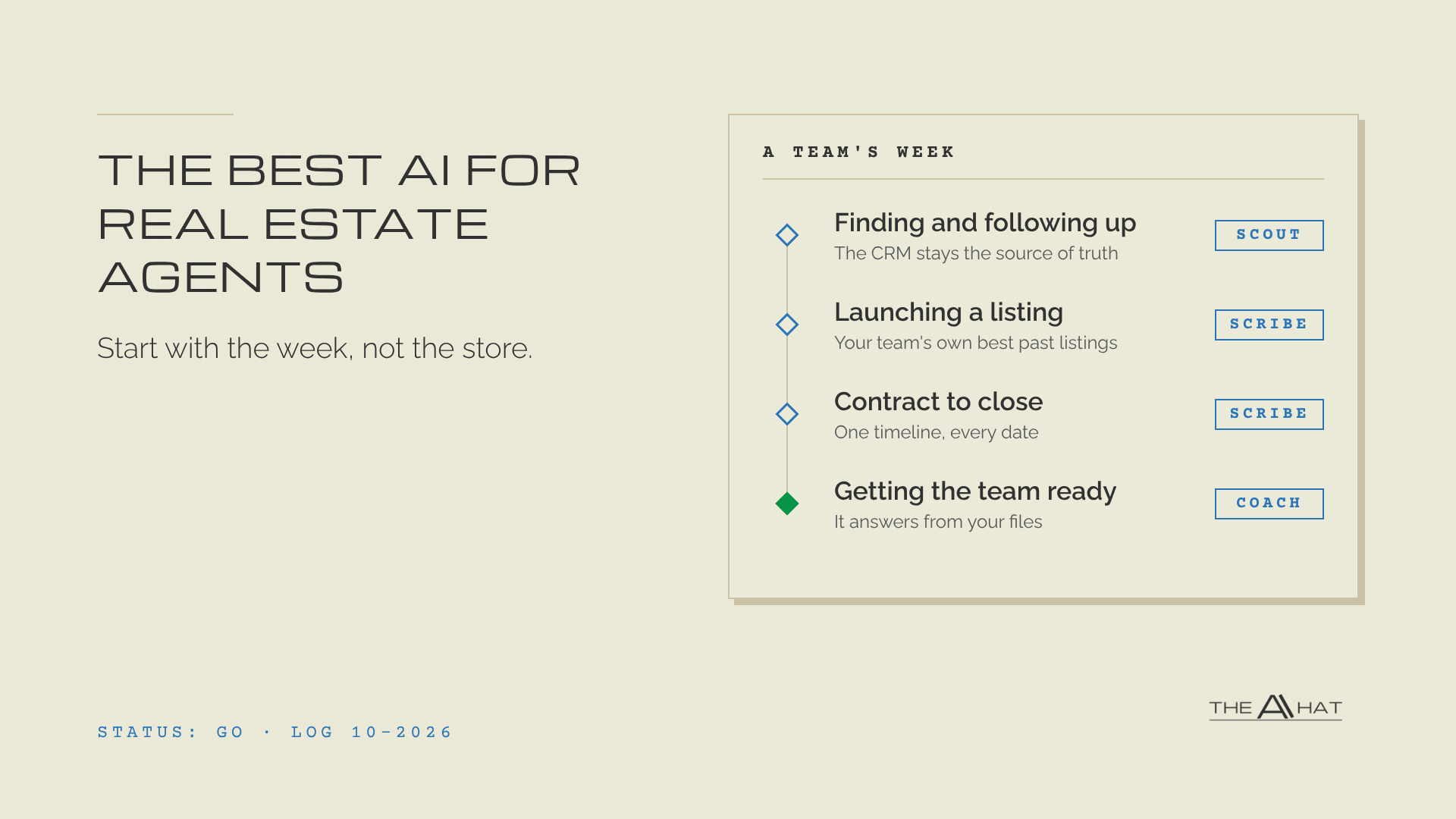
An agency's month breaks into roughly four stretches of work that isn't strategy. Each has a different shape, so each needs a different kind of tool. The three crew seats, Scout, Scribe and Coach, map onto them, which helps later when you decide who owns what.
Winning and keeping the work
This is Scout's stretch. Before a pitch, someone pulls together what's public about the prospect: their site and the roles they're hiring for. Between reports, someone should be watching each client's numbers for the swing an account manager needs to hear about before the client calls. A general-purpose assistant such as ChatGPT, Claude, Gemini or Copilot handles the pitch research well from public sources. For the client numbers, check what your analytics and reporting tools can already do before you buy anything. The assistant works from what they export. It never becomes a second set of dashboards that only one person checks.
The month-end report
This is usually the first job an agency thinks of handing to AI, and for good reason. Someone pulls numbers from four or five dashboards, pastes them into the client's deck and writes the paragraph about what happened. That paragraph is Scribe work. A general-purpose assistant drafts it well from the exported numbers, provided it also has that client's own past reports as examples. The account manager edits it and puts their name on it.
Keep the numbers and the narrative apart. Your reporting tool, or a spreadsheet you trust, produces the figures, and the AI writes about them. Ask an assistant to work out a client's month from a pasted screenshot and it will sometimes get a figure wrong, and one wrong number in front of a client costs more than the hour you saved.
One piece into many
Tuesday's webinar has to become posts, an email and a blog draft by Friday, each in the client's voice and checked against a brand guide nobody has open. A general-purpose assistant set up per client, with that client's style guide and best past posts loaded as reference, writes good first drafts for every channel. The setup is the real work here: one project or workspace per client, so one client's voice and material never leak into another client's drafts.
Keeping the team and the brand straight
Coach's stretch is the one agencies skip, and it's the one that keeps paying, because every person you hire after today uses it too. A new hire has a dozen how-do-we-do-this questions a week, and the answers live in your head or in a shared drive nobody opens. Put your playbook and each client's brand guide into an assistant that answers from your files instead of the internet, and a new hire asks it first and asks you second. The same setup runs a QA pass before anything goes to a client: tone, banned words, the claim the client's legal team won't let them make. It tells the account manager what it found. It doesn't fix the piece and send it.
Before client material goes in
Your team works inside other companies' numbers and customer lists, usually under an NDA. If your agency is like most, someone is already pasting client material into a personal AI account, and you don't know who or what. Banning it won't stop it. It just goes quiet.
Governing it is short work. Pick the tools the team may use, on accounts the agency controls rather than personal ones. Decide which client material goes where: a published blog post can go almost anywhere, a client's customer list only into the tool you've approved for it, and some clients won't allow any of it, so check the contract. Then, for every job you hand to AI, write down two things: the person on your team who owns it, and the decision it never makes. No strategy, no scope or price, and nothing a client sees until a person has approved it.
Ownership of AI-made work belongs in that conversation too, and it's less settled than most contracts assume (Do you really own the AI content you're selling to clients?). If you'd rather start on your own, the Shadow AI Governance Launchpad is free.
Where to start this month
Pick one client and one deliverable. The method I use with clients is the Walkdown: follow that deliverable, start to finish, the way it actually got made last month. Question every step, because a step with no reason on file gets scrubbed. Then decide which of the steps that survive belong to a person, which to a simple automation and which to an AI agent. Last, check it with the account manager who does the work. If they say it didn't help, it goes back to the start.
Out of that walk, pick the step that ate the most hours. Give it to the AI you already pay for, set up for that one client, on an account the agency controls. Name the person who owns it and write down the decision it never makes. That's your first crew member, and like the pit crew, you assigned the job before anyone went shopping.
If your agency is a dozen people or fewer and you'd rather hire that first crew member with help than by trial and error, that's what a Crew Launch is. Two live sessions: your team trained on the one AI you've chosen, then your first Digital Crew member hired from your own work, with a named person on your team who owns it.
FAQ
Do we need a different AI tool for every client?
Usually not. One general-purpose assistant on an agency account, with a separate project or workspace for each client, keeps each client's voice and material apart. A second tool earns its place when a client's contract requires it, or when it lives inside a system the team already works in every day.
Can AI write client reports without getting the numbers wrong?
Let it write about the numbers and leave producing them to your reporting tool. Give the assistant the export and last month's report, and have the account manager check every figure in the draft before it goes out.
Should we tell clients we use AI?
Have the answer written down before a client's procurement team asks for it: which tools, what client material goes into them, and who reviews what comes out. Some clients will want it in the contract, so read yours before you assume what's allowed.