A restaurant that wants a better menu has three ways to get one. It can hire a new chef. It can send the line cooks to a class. Or it can bring in a chef for a few weeks who cooks alongside the team until the new dishes belong to the kitchen.
Each of those works somewhere, and each one fails in a way you can see coming. The new chef eventually leaves and takes the menu with him. The class teaches knife work nobody has time for during a Friday rush. The visiting chef's dishes quietly disappear a month after the visit, because nobody in the kitchen was ever told they were theirs.
A business deciding how to make AI stick is standing in the same kitchen, whether it sells insurance, runs a sales floor or manages a marketing team. You can hire someone whose job is AI, train the whole team, or bring in outside help. I'll walk through all three as fairly as I can, including when doing it yourself is the right answer. You should know going in that I'm one of the options.
Why the question comes up at all
Most leaders I talk to are past the question of whether to use AI. Their people already do, a pilot ran sometime last spring, and someone on the team is quietly good at it. What they want to know is why it hasn't stuck, and why the tool everyone was excited about in March is a tab nobody opens in October. I've written about where AI pilots tend to stall in insurance agencies, and the pattern holds well outside insurance.
Picking the tool turns out to be the easy decision. This one is harder: who makes AI part of the team's actual week, and who answers for it when it gets something wrong.
Route one: hire someone whose job is AI
A dedicated person has the one thing nobody else on your team has, which is time. They can learn the tools properly, build the first workflows, and become the person everyone asks before pasting a customer's details into the wrong window.
Where it stalls is concentration. Everything that works lives in one person's head, and the rest of the team starts treating AI as that person's department. When they leave, and good people do, the workflows leave with them. Finding the right hire is its own problem, too. Someone who understands both the tools and how a deal, a claim or a client file actually moves through your business is rare, and the months they spend learning your operation are part of what you're paying for.
This route is right for a business with enough work to keep someone busy full time and a leader willing to make it a real role with authority across departments. It isn't a side job for whoever's best at ChatGPT. The test is simple: write the job description before you post it, including what this person owns and what they never decide. If you can't write it, you're not ready to hire it.
Route two: train the team
Training gives everyone the same starting point, costs the least per person, and puts the learning closest to the work. People learn on their own customer emails instead of on someone else's demo.
It stalls when there's no job waiting on the other side of the session. A team that learns a tool on Tuesday and goes back to the same week on Wednesday will drift back to the old way by Friday. Training teaches the tool. It doesn't decide which part of the week the tool takes over, or who owns what it produces. I've written about why most AI training fails insurance agents, and the reasons travel to any team.
When it works, it looks like Brandon Johnson. Brandon manages the Life, Health and Wealth department at Main Street Insurance in Utah, and before the Kellogg Business Summit he was very reluctant, sure he didn't have time to learn AI. Sixty days later he was using it every day, several times a day, for client communications, property and casualty proposals, executive summaries for the retirement plans he develops, and working through complex figures. His line was "My staff and I don't have time not to learn it."
Look at what he used it for. Every item on that list was work already sitting on his desk. Training sticks when it lands on a job the person does every week, which is why the right time to name that job is before the training starts.
Route three: bring in outside help
Outside help brings something the other two routes don't: someone who has done this at other companies and has watched it fail in ways you haven't yet. A good outside partner redesigns the work before touching a tool, moves faster than a new hire can, and doesn't need six months to learn how your business runs.
It stalls in exactly the way the visiting chef does. The help builds something clever, the engagement ends, and nobody inside was ever made the owner of it. Expertise doesn't protect anyone from building the wrong thing, either. I once spent a couple of hours trying to build an AI agent in Zapier, and instead of a smart agent I ended up with a more and more complex automation that I eventually abandoned. Experience mostly means you abandon the wrong build sooner.
This route is right when you need something built and handed over, and when you treat the handover as the deliverable. Before the help leaves, every workflow they built should have a named person on your team who owns it. If a partner can't tell you who that person will be at the start, find a different partner. That includes me.
What outside help looks like at each size
Bringing in help covers a wide range, and the right shape depends mostly on how many people need to change how they work. These are the three I run, laid out so you can compare them even if you end up hiring someone else.
A small team, start to finish. For a team of up to twelve, or a team of one, a Crew Launch is two live sessions. In the first, your team trains on the one AI you've chosen. In the second, we walk one real workflow and hire your first Digital Crew member from it, with a named person on your team who owns it. A short survey beforehand shows where the hours actually go, and the same survey at ninety days shows what changed.
A bigger room, in one day. A hands-on workshop puts everyone in the room to work on their own tasks, in the AI tool the company already uses, on site or virtual. It fits well inside an annual meeting or a sales kickoff, after a keynote has made the case. When Nevco Sports brought me to its national sales meeting, the keynote ran an hour and the build session ran four. Kenneth Turner, their Director of Sales, put it this way: "Our sales team left that session having built their first agents and with a clear understanding of how AI tools can eliminate the daily administrative drag that keeps great salespeople from doing what they do best: selling."
A whole organization, over a year. One day gets people started. An organization with many teams, or a network of member businesses, usually needs the work spread out: training cohorts as people are ready, build sessions month by month on the workflows that matter most, and a review of outcomes at the end of the year. That's a program. It fits when what has to change is how a whole organization works. Turner said much the same about Nevco after that first day: "This is not a one-and-done engagement for us. It is the beginning of a partnership."
When doing it yourself is the right call
Plenty of businesses should start in-house, with no hire, no training budget and no outside help. A smaller shop with one obvious bottleneck and an owner or ops lead who enjoys this kind of work can get a long way alone.
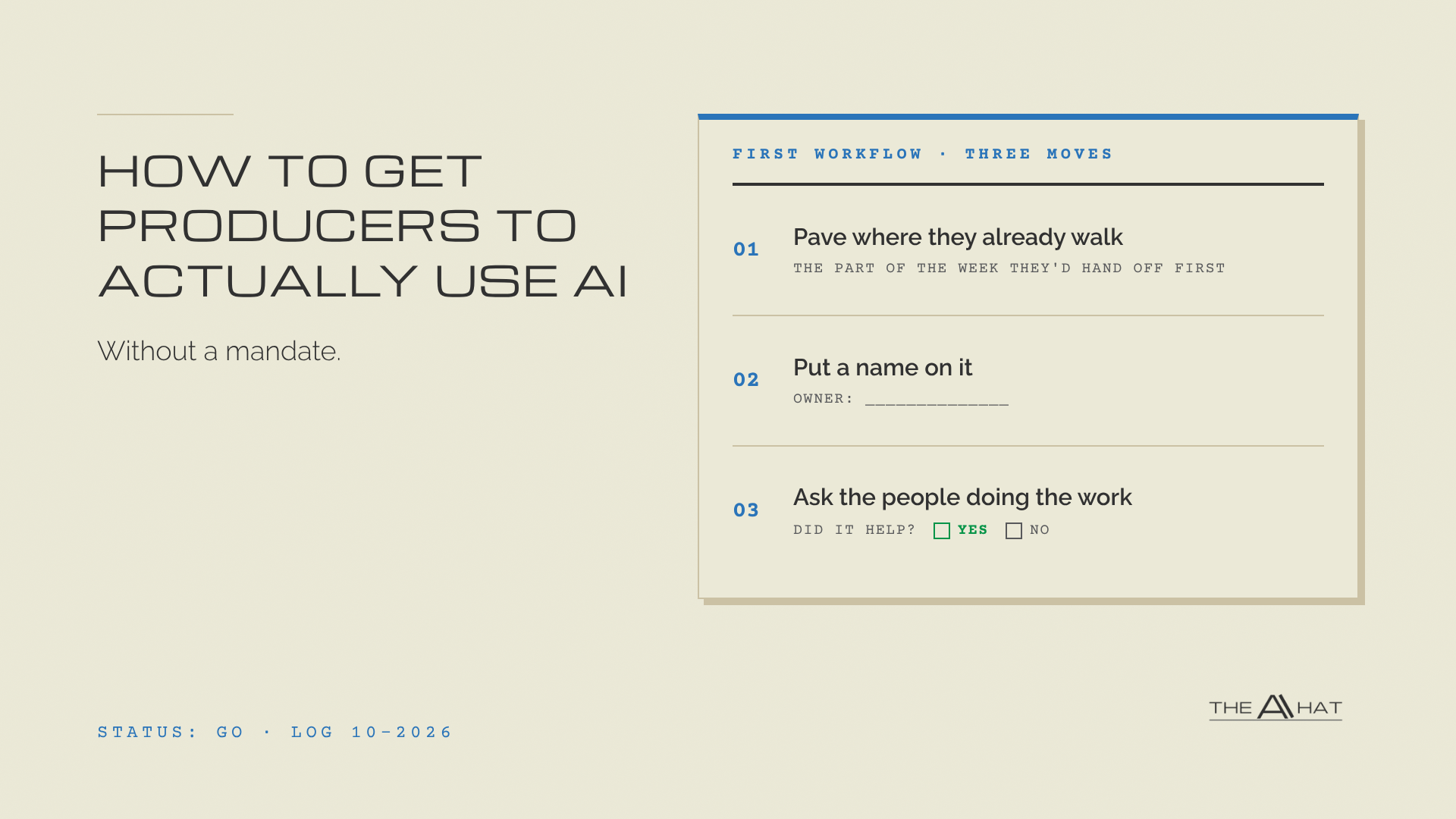
The method I use with clients is the Walkdown, and you don't need me to run it. Walk one real piece of work start to finish, the way it actually happened last week. Question every step, because a step with no reason on file gets scrubbed. Then decide which of the surviving steps belong to a person, a simple automation or an AI agent, and check with the people doing the work whether it helped. The only thing doing it yourself costs is your own hours, and that's a real cost, so be honest about how many you have.
The part all three routes share
Whichever route you pick, the work underneath it is the same. Pick one workflow. Walk it. Then name two things before any AI touches it: the person on your team who owns the output, and the decision the AI never makes. A client report drafted by AI still goes out under someone's name, and that someone should know it's theirs before the first one is drafted.
The three routes only change who does the walking and who helps. A hire walks it alone, training teaches everyone to walk it, and outside help walks it with you. The businesses where AI sticks are the ones where, at the end, somebody inside the building owns every piece of it. That's the chef whose dishes stay on the menu.
If you're weighing these routes and want a straight read on which one fits, and which shape of help makes sense for your team, book an AI Strategy Call. It's thirty minutes, we look at where the hours actually go in your team's week, and if the honest answer is that you should do it yourself, I'll tell you that.
FAQ
Do we need a Chief AI Officer?
Most companies don't need the title. They need someone with the authority to decide which workflows change and the time to see it through, and in a smaller company that's often the owner or an operations lead. The title matters less than whether that person owns the outcome.
How do we know if it stuck?
Ask at sixty days. By then a new habit has either become part of the week or quietly died. Two questions are enough: are you still using what you built, and what's it handling for you? Ask for the failures too, because those answers are what make the successes believable.
Can we combine routes?
Yes, and many companies should. A common pairing is outside help to build the first workflow and train the people who'll run it, with a named person inside who owns it from day one. What doesn't work is any combination where the owner gets decided after the help has left.