Back in December 2024, I pulled over on a two thousand mile drive with nothing but a blinking cursor and an uncomfortable question. I'd been using AI every single day. I had all the right tools. Business felt fine on paper. But I was capped, and I finally admitted why. I wasn't operating like a chief strategist. I was an architect who'd spent years laying bricks instead of designing buildings.
That was the moment I stopped treating AI like a search engine and started treating it like a strategic partner. Not by asking it for content. By asking it for counsel.
Here's the thing most people never get past. They open ChatGPT or Claude or Copilot, they throw in five seconds of a sentence, "write me a LinkedIn post" or "help me draft this email," and they get back something they have to spend the next half hour rewriting. Then they think, "I could've just written this myself." And they're not wrong, because the output was never going to be good. The AI didn't have anything to work with.
That's not an AI problem. That's Admin Drag wearing a new outfit. You've swapped one kind of low-value busywork, the copy-paste, the reformatting, for another, the endless prompt-and-revise loop. Same drag, different chair.
The fix isn't a better prompt. It's better onboarding.
Think about the last time you hired someone brilliant. PhD-level smart, genuinely a joy to work with. On day one, did they know your business? Your target audience? Your quota? The products you actually sell? Of course not! You onboarded them, because that's what you do with anyone talented but new. AI deserves the same courtesy, and when you give it, the difference in output becomes clear.
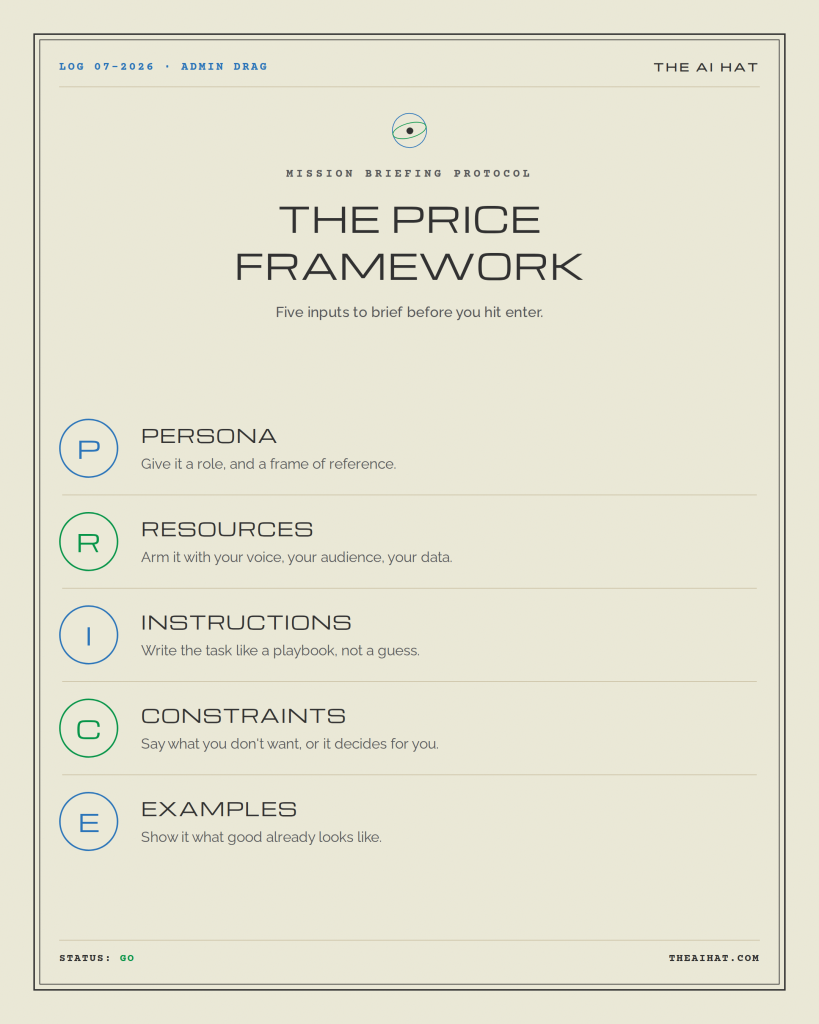
That's what PRICE is for. Five things to hand the AI before you hit enter, whenever the task actually matters.
Persona
Give the AI a role. A job title, a level of experience, a frame of reference. "You are a senior marketing strategist with ten years of experience" doesn't unlock secret knowledge; the AI already knows what it knows. What it does is change how that knowledge gets applied, the same way a request lands differently depending on who's in the room when you make it.
Resources
Arm it with what it needs to sound like your business, not every business. Not proprietary data, not anything personally identifiable, just the general shape of who you are and who you're talking to. A brand voice guide. A target audience description. If you want a sales message that actually sounds like your buyers, give it real voice of customer, transcripts, reviews, the actual words people use when they talk about the problem you solve. People do business with people they recognize, and recognition starts with language.
Instructions
This is the part everyone assumes they've already done. Be specific about the task. Don't make the AI guess what "help me with this email" means. Write it like a playbook: what's the goal, what's the format, what happens next. Ambiguity here is what sends you down the wrong road for half an hour.
Constraints
What don't you want? Length limits, no bullet points, no emoji, no fluff, whatever matters for this particular piece. If you don't say it, the AI will make its own call, and it usually won't be the one you wanted.
Examples
This is where almost everyone drops the ball, even people who've been doing this a while. Ask for a LinkedIn post with no example, and you'll get an average LinkedIn post, because the AI scoured the internet and handed you back the internet's version of average. That's not you. Give it your best past post, your best email, your best whatever you're asking for, and now it has something worth mirroring instead of guessing at.
Run those five through your head before an important prompt, and you'll be most of the way to something usable before you've even asked the question. You won't need this every time; a quick fact doesn't need PRICE. But the meeting recap, the client proposal, the sales follow-up that actually matters? Run it through PRICE, and watch how much less revision you end up doing.
And once this becomes a habit, you'll notice something bigger hiding in plain sight. PRICE isn't really a prompting trick. It's a briefing. Persona is the job title. Resources are the onboarding packet. Instructions are the role, Constraints are the working agreements, Examples are what good looks like in your shop. You're not writing prompts anymore; you're briefing a new hire, which is exactly the argument I've come to build my entire business around: AI belongs on your org chart, not your tech stack. PRICE is how you brief the hire. The manifesto makes the case for which seats to fill, and the one on my own chart I'm deliberately leaving empty.
That's the real trade here. Not fewer tasks. Less Admin Drag on the tasks you keep. The work stays. The drag doesn't have to.
A PRICE brief pays off most on the task that's costing you the most time. If you don't know yet which one that is, the AI Opportunity Score takes about three minutes and shows you, then gets you a starter crew member built for it.
Try PRICE on the next prompt that actually matters this week. I think you'll feel the difference on the very first pass! Then find me on LinkedIn and tell me what changed.