Fifty-seven years ago this week, the most important computer in the world started throwing alarms.
Minutes into Apollo 11's final descent, the guidance computer flashed a code almost nobody had ever seen in flight: 1202. Armstrong asked for a reading on it. And in mission control, a 26-year-old guidance officer named Steve Bales had seconds to decide whether to abort the Moon landing.
He called GO. Not because he blindly trusted the machine, but because his team had done the work. They'd rehearsed the failure modes weeks earlier in simulation. They knew the computer was overloaded and shedding low-priority tasks exactly as it was designed to. They knew precisely where the machine's judgment ended and theirs began.
The computer flew the ship. A human owned the outcome. That division of labor is what put people on the Moon.
Hold onto that, because last week the rest of us got our own guidance computer - and almost nobody is asking who's sitting at the console.
The coworker in the box
Last week, OpenAI rebuilt ChatGPT into a coworker. Not a chatbot with a fresh coat of paint - a coworker. There's a new Work mode that takes a goal, breaks it into steps, pulls context from your connected apps and files, and keeps going for hours. There are Skills that teach it to do a task your way, every time. There's a desktop app with a built-in browser that can click, type, and move files on your machine. All of it ships on every plan, including free.
The AI employee - the thing practitioners like me have been building for early-adopter teams for two years - is now the default product for hundreds of millions of people.
And if this sounds familiar, it should. Anthropic shipped this way of working back in January with Claude Cowork - the launch coverage flat-out called Work OpenAI's answer to it. That matters, and not as a scoreboard. When the labs start copying each other's coworkers and giving them away free, you're watching the price of a capability fall to zero in real time.
If your inbox looks anything like mine, you already know. The masterclass invites, the AI employee blueprints, the breathless breakdowns. Everyone is suddenly teaching you how to hire your first AI staff member.
Here's the thing. The instinct behind all of it is correct. And the framing is a trap.
Let me show you both.
The instinct is right
For two years I've been telling rooms full of leaders to stop settling for chatbots that talk and start building agents that do. Stop asking AI to draft the email. Start handing it the research, the CRM updates, the follow-ups, the paperwork - the Admin Drag that swallows most of your best people's week.
That shift, from generative to agentic, is the whole ballgame. And as of last week, the biggest AI company on the planet agrees. They didn't ship a feature. They shipped a way of working.
So no, I'm not here to tell you the AI employee crowd has the wrong premise. The premise is proven now.
But two things changed the moment that announcement went live, and most of the people teaching you to build an AI employee will mention neither.
First: the tools stopped being the edge
When a capability ships free to everyone, it stops being a differentiator. Your competitors have Work mode too. They have Cowork. They have the same models, the same Skills, the same desktop agent. By next quarter, so will their interns.
Which means the question is no longer whether you have access to an AI that can do real work. Everyone does. The question is whether your work is designed for it.
And on that question, the track record is brutal. Roughly 95% of AI pilots fail to produce measurable ROI - not because the models were weak, but because teams bolted AI onto broken workflows and hoped. Bolt a smarter model onto a broken workflow and you get the same broken workflow, faster. That's Pilot Purgatory, and better tools don't get you out of it. Redesigned work does.
I learned that on a small scale long before I taught it from a stage. The first AI assistant I ever built took my podcast prep from two hours an episode down to twenty minutes - and the win wasn't the model. It was sitting down first and redesigning how prep happened at all: what got batched, what got templated, what only I could do. Same tools everyone else had. Different work. That one redesigned workflow is how I ended up running five shows instead of one.
The edge didn't disappear last week. It moved - from access to design. And design is exactly the step most teams skip.
Second: the employee framing has a price tag
This is the part nobody selling an AI employee blueprint wants to talk about.
A Boston University and BCG study published this spring surveyed more than 1,200 managers. About a third said their leadership now positions AI as employees or teammates. Nearly a quarter said their organization has started placing AI agents on the org chart.
Then the researchers measured what that framing does. When AI is presented as an employee, managers catch 16% fewer of its errors. They ask other people to review its work more, and responsibility for mistakes drifts away from the humans and onto the system.
One company in the research gave its agent a human name - Kevin. When something went wrong, the conversation became "Kevin made a mistake. Why did Kevin make a mistake?"
Notice the question nobody asked: who was supposed to be checking Kevin's work?
That's the trap. The employee framing doesn't make the AI more capable. It makes your people less careful. Call it an employee and they'll treat it like one - they'll trust it, assume someone else is watching, and stop verifying. Except an agent isn't a colleague with judgment and a stake in the outcome. It's a tireless, talented system that fails in ways people don't expect, at a speed people can't match. The framing hands it exactly the unearned trust it can't handle.
What to build instead: a crew
Apollo didn't fly because NASA hired the guidance computer. It flew because a crew had names, roles, checklists, and a flight director who was always, unambiguously in command. Nobody in that control room confused the computer with a colleague. And nobody stopped checking its output, either.
That's the model. A Digital Crew, not an AI employee.
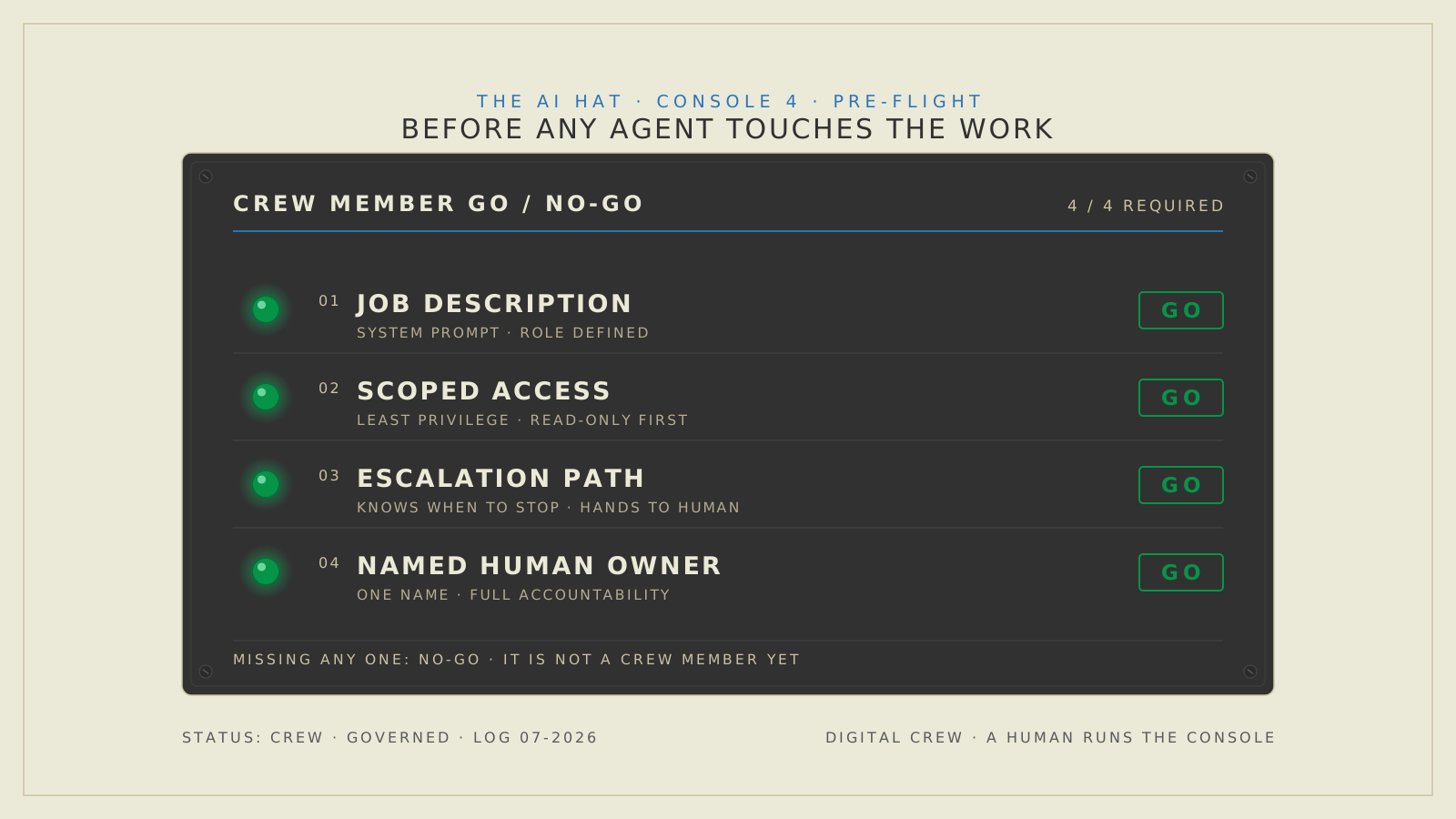
The difference isn't semantics. It's structure. Every member of a Digital Crew gets four things the AI employee pitch never mentions:
- A written job description. The system prompt defines exactly what the agent does - and, just as importantly, what it doesn't.
- Scoped access. It touches the systems its job requires, read-only where possible, and nothing else.
- An escalation path. It knows when to stop and hand the work to a human, and that threshold is deliberate, not accidental.
- A named human owner. One person answers for the agent's output. A name, not a department.
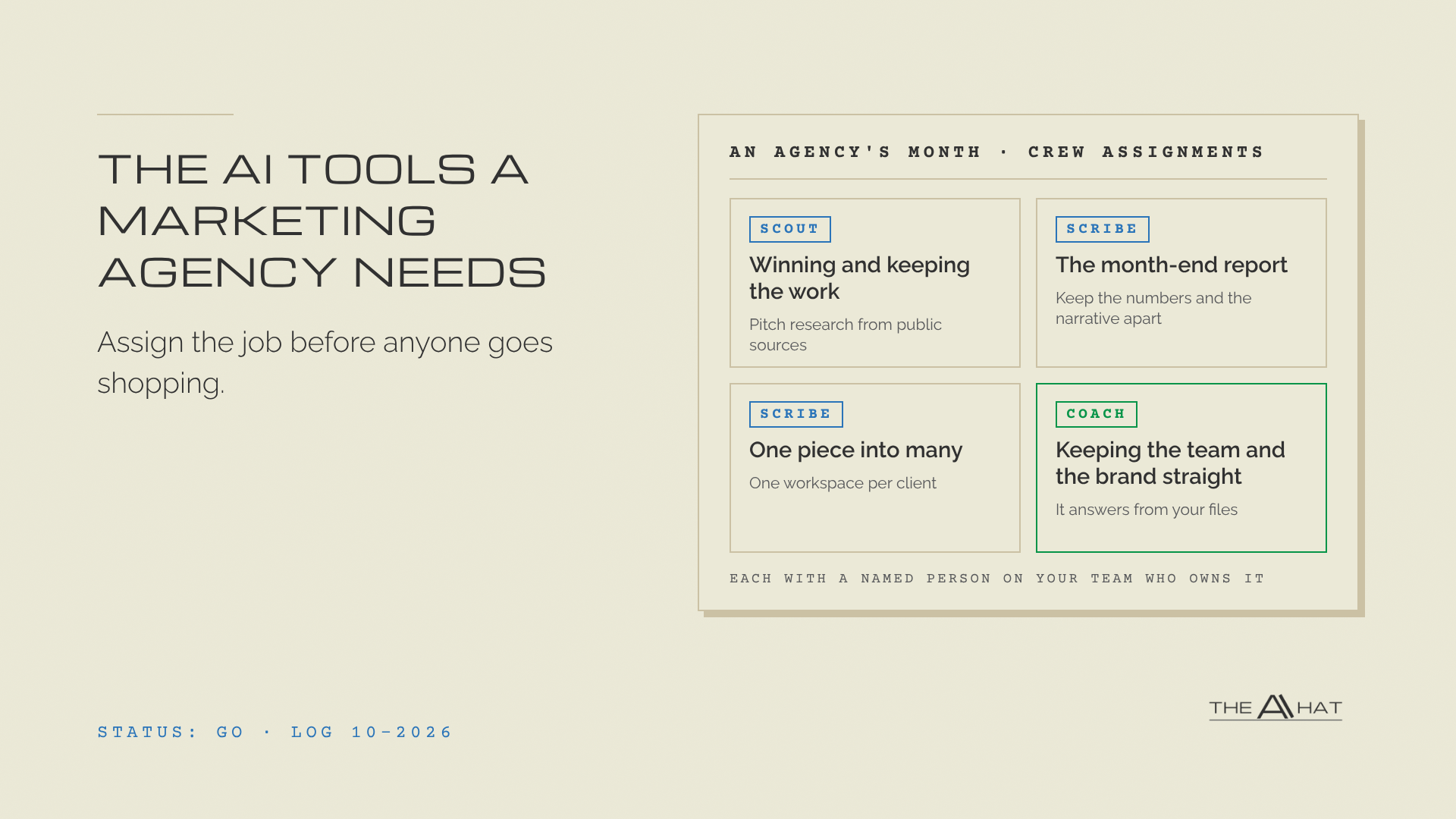
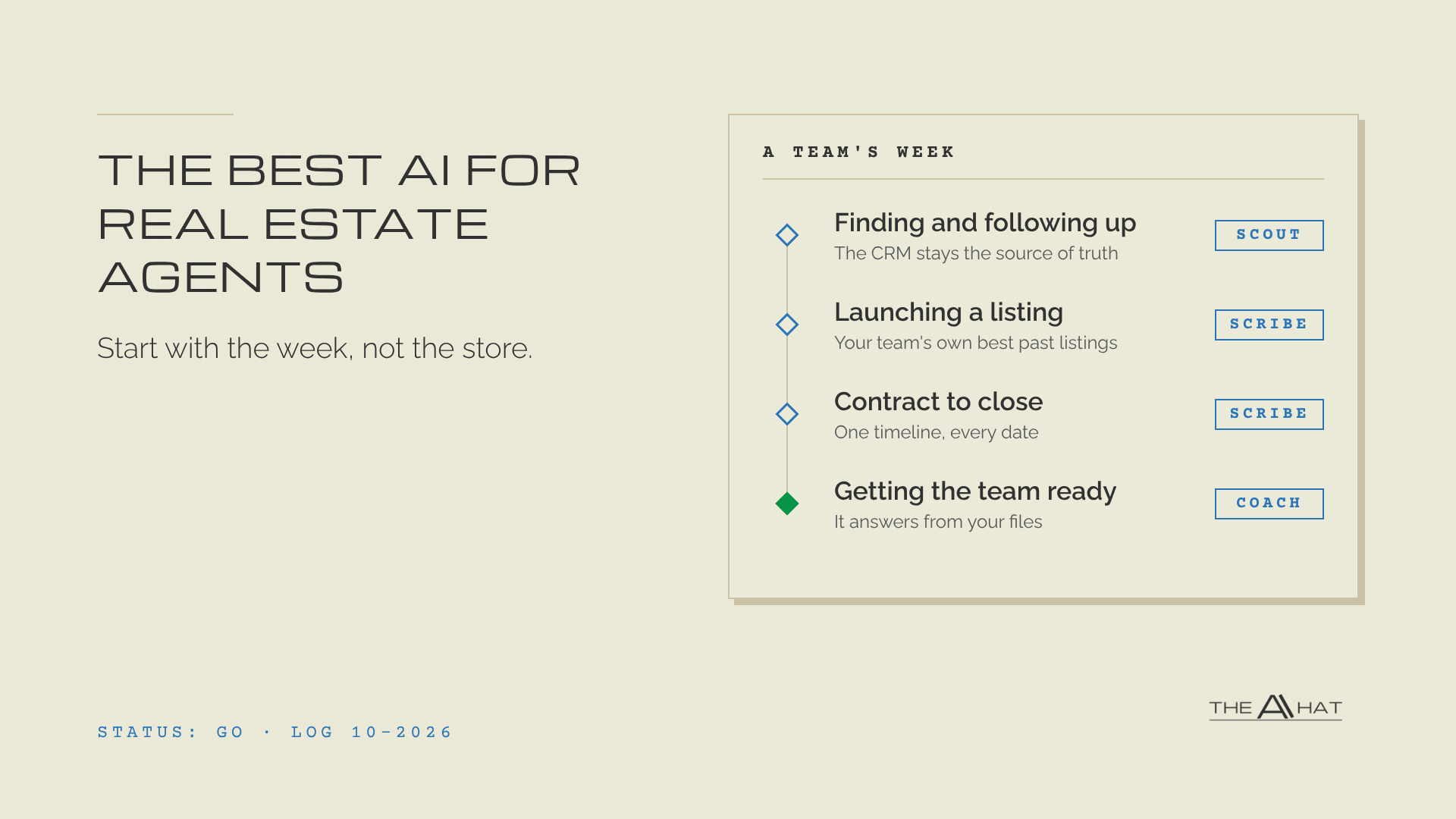
In the crews I build, those roles have names. Scout finds and qualifies - the leads, the claims, the research. Scribe handles the admin - the notes, the CRM updates, the follow-ups, the paperwork. Coach briefs your people and gets them ready for the conversations only they can have.
And a human runs the console. Always.
The work in front of you
When you're ready to build - and after last week, the ready-or-not clock is running - the sequence matters more than the software. Illuminate the Shadow first: find out where your people actually lose the week, and where ungoverned AI is already quietly in use. Then build your first agent - one role, one workflow, redesigned before a single prompt gets written. Then, and only then, scale the crew.
Your best people didn't join your team to re-key data and chase follow-ups. The technology to take that off their plates just became free and universal. What's scarce now - what was always scarce - is the discipline to redesign the work and keep a human in command.
Everyone has an AI employee now. The teams that win won't be the ones who hired one. They'll be the ones who built a crew.
So here's my question for you: if you named one agent tomorrow, what job would you give it - and who on your team would own its work?